In This Article
What This Means
- NIST’s PQC Standards: What Enterprises Need to Know
- Translating Standards Into Actionable Enterprise Strategy
- How QuantumGenie Fits Into PQC Migration and Compliance
NIST’s PQC Standards: What Enterprises Need to Know
In August 2024, NIST finalized the first three post-quantum cryptography standards, setting formal guidance for organizations to transition legacy cryptographic systems to quantum-resistant algorithms. These standards are designed to counter the threat posed by quantum computing capabilities that could decrypt today’s resilient encryption schemes, jeopardizing sensitive data and communications.
The formalization of FIPS 203, 204, and 205 offers enterprises a vetted set of algorithms for key establishment and digital signatures that promise durability against quantum attacks. This milestone removes uncertainty around which cryptographic approaches organizations should adopt and accelerates requirements for enterprise security architects and CISOs to begin methodical migration planning.
Translating Standards Into Actionable Enterprise Strategy
While the standards provide the blueprint, the enterprise journey towards quantum-safe security is complex. Legacy systems embed cryptography deeply—in websites, applications, certificates, databases, infrastructure components, and integrations—making blind migrations risky and costly.
Organizations must first discover their cryptographic footprint comprehensively. Understanding precisely where vulnerable algorithms reside and assessing their usage context is foundational. This discovery informs the construction of a cryptographic bill of materials (CBOM) and enables risk prioritization aligned with business-critical assets. Furthermore, enterprises need workflow-driven orchestration capabilities to plan, validate, and implement migration without disrupting operations.

Summary of Enterprise PQC Migration Considerations Post-NIST Standards
| Focus Area | Enterprise Imperative | QuantumGenie Capability |
|---|---|---|
| Cryptographic Asset Discovery | Comprehensive inventory across all systems and environments | CipherScan's deep scanning and inventory across certificates, code, and infrastructure |
| Risk Prioritization | Identify critical vulnerabilities and prioritize migration tasks | Risk assessment modules linked to asset criticality and exposure |
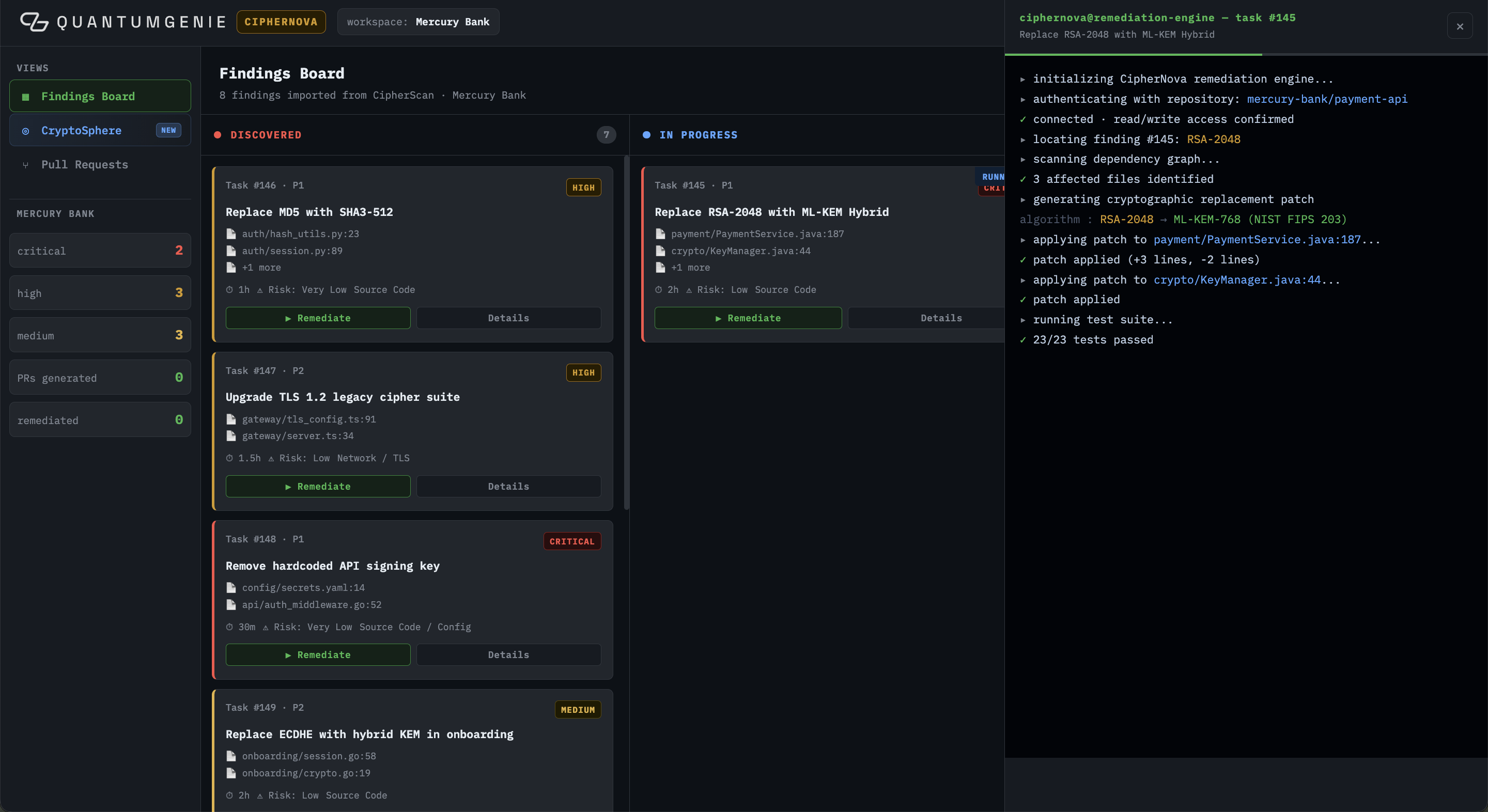
| Migration Orchestration | Plan and execute algorithm transitions with minimal disruption | CipherNova workflow orchestration with change review and policy enforcement |
| Compliance Readiness | Maintain evidence and audit trails for regulatory adherence | Built-in reporting aligned with standards and audit needs |
How QuantumGenie Fits Into PQC Migration and Compliance
QuantumGenie plays a pivotal role by offering a comprehensive platform that discovers, inventories, and assesses cryptographic assets enterprise-wide to build an actionable CBOM aligned with NIST’s PQC standards.
Its CipherScan component ensures continuous and detailed visibility into cryptographic exposure, enabling proactive risk management before a migration begins. CipherNova then operationalizes remediation plans through workflows, policy enforcement, and verification steps, facilitating smooth cryptographic transitions that satisfy emerging regulatory and compliance demands.
Frequently Asked Questions
Why is the finalization of NIST’s PQC standards crucial for enterprises?
NIST's standards provide validated and government-backed algorithms designed to resist quantum attacks, giving enterprises definitive guidance for secure cryptographic migration and reducing uncertainty in selecting quantum-resistant solutions.
How does cryptographic discovery impact PQC migration success?
Without a thorough understanding of where and how cryptography is used enterprise-wide, attempts to migrate to PQC can miss critical assets or disrupt services. Discovery enables informed risk prioritization and effective migration planning.
Watch The Quantum Threat
Sources And Further Reading
- NIST Finalizes First Post-Quantum Encryption Standards NIST · Aug 13, 2024
- IBM-Developed Algorithms Formulate World's First Post-Quantum Cryptography Standards PR Newswire · Aug 13, 2024
- NetSfere Integrates Post-Quantum Cryptography to Enhance Secure Communication GlobeNewswire · Sep 26, 2024