In This Article
What This Means
- Emerging Data on Post-Quantum Cryptography Adoption
- Real-World Enterprise Migration Challenges and Signals
- How QuantumGenie Fits: From Visibility to Migration Workflow
Emerging Data on Post-Quantum Cryptography Adoption
A recent study published on arXiv presents a novel PQC network instrument designed to measure adoption rates and migration pathways across enterprises. This marks a critical shift from theoretical PQC readiness discussions toward data-driven understanding of what organizations are actually doing in production environments. The research highlights early adoption is happening but is uneven, with many firms struggling to identify where cryptography lives and how to plan phased migrations safely.
Real-World Enterprise Migration Challenges and Signals
The findings underscore practical obstacles: incomplete cryptographic inventory, lack of migration prioritization, performance concerns, and the complexity of integrating PQC standards into existing systems. Supporting reports echo these hurdles. For instance, new tools launched to test PQC performance impact help firms anticipate operational changes, while enterprise platforms are emerging to align with governmental standards like NIST’s finalized PQC algorithms and NSA’s CNSA 2.0 framework. These developments signal a maturing PQC market, but enterprises must actively manage risk and complexity instead of reactive scrambling.
Key PQC Adoption Challenges and QuantumGenie Solutions
| Challenge | Enterprise Impact | QuantumGenie Capability |
|---|---|---|
| Incomplete Cryptographic Visibility | Difficult to locate all cryptographic dependencies, risking overlooked vulnerabilities | Comprehensive discovery via CipherScan for cryptographic inventory |
| Migration Prioritization Difficulty | Unclear which assets pose highest risk or require urgent migration | Risk scoring and prioritization of critical cryptographic exposure |
| Integration Complexity | Hard to track remediation progress and enforce governance | Remediation orchestration with pull requests, policy exceptions, and verification workflows |
| Performance Impact Uncertainty | Potential degradation deters deployment speed | Enables planning around migration impact through visibility and phased execution |
How QuantumGenie Fits: From Visibility to Migration Workflow
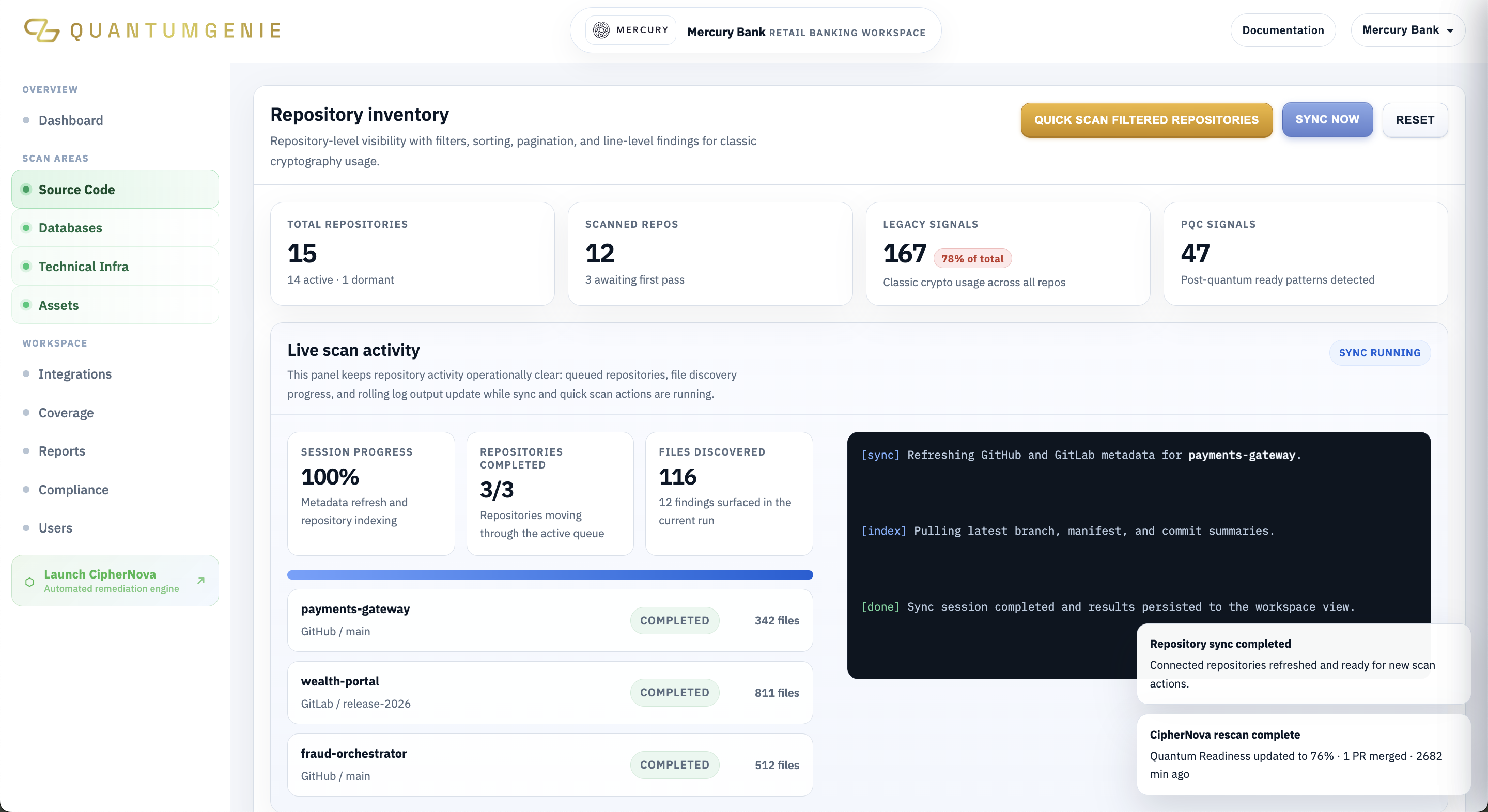
QuantumGenie addresses the core gap revealed by these insights — operational visibility coupled with governance to prioritize and execute PQC migration effectively. By discovering cryptographic assets across applications, infrastructure, certificates, and source code, QuantumGenie builds a precise cryptographic inventory and cryptographic bill of materials (CBOM). It then enables risk prioritization and migration planning aligned with standards. Crucially, the platform supports remediation workflows, exception management, and verification to operationalize and govern the entire migration lifecycle. Enterprises leveraging QuantumGenie can move from uncertainty to controlled, transparent PQC transitions that mitigate harvest-now-decrypt-later threats and compliance risks.
Frequently Asked Questions
Why is measuring PQC adoption rates important for enterprises?
Measuring adoption rates helps enterprises understand industry trends, benchmark their readiness, identify common challenges, and prioritize their migration activities to mitigate quantum risks effectively.
How does QuantumGenie help with governance during PQC migration?
QuantumGenie provides structured workflows, policy exception management, and verification checks that ensure remediation steps comply with organizational standards and regulatory frameworks throughout the migration process.
Watch The Quantum Threat
Sources And Further Reading
- Post-Quantum Cryptography Network Instrument Measures Adoption Rates and Migration Pathways arXiv · Jul 31, 2024
- Quantum Secure Encryption Corp. Launches QPA v2 for Enterprise PQC Migration Nasdaq · Apr 6, 2026
- VIAVI Introduces Performance Testing for Post-Quantum Cryptography Deployments PR Newswire · Apr 9, 2024