In This Article
What This Means
- The Visibility Challenge in Post-Quantum Migration
- Moving Beyond Discovery: Continuous Adaptation to Quantum Threats
- How QuantumGenie Fits: From Discovery to Migration Orchestration
The Visibility Challenge in Post-Quantum Migration
As quantum computing advances, the urgency for enterprises to transition to quantum-resistant cryptography intensifies. Yet many organizations face a critical barrier: they lack a comprehensive, business-contextualized inventory of their cryptographic assets. The recent launch of Qinsight's Cryptographic Posture Management platform underscores this challenge and signals a vital market evolution. By discovering and enriching cryptographic assets with business context, it empowers CIOs and CISOs to gauge quantum risks accurately and prioritize migration efforts effectively.
This kind of cryptographic inventory is not merely a compliance checkbox; it’s a strategic asset. Without visibility, enterprises risk the widespread presence of outdated or vulnerable algorithms lurking in legacy systems, third-party integrations, and obscure certificates — all potential points of quantum exploit. Qinsight's approach highlights how foundational inventory is to any successful post-quantum migration roadmap.
Moving Beyond Discovery: Continuous Adaptation to Quantum Threats
Supporting this inventory-focused perspective, recent initiatives like PKWARE’s re-architected key management layer demonstrate the need for agility after discovery. Transitioning away from cumbersome, multi-quarter migrations towards agent-based, incremental updates is essential to respond swiftly as NIST standards evolve and new quantum threats emerge.
Similarly, platforms such as Cybernonics’ QuantumGuard reinforce the importance of not only identifying cryptographic vulnerabilities but orchestrating migration to NIST-approved algorithms at scale. These developments converge on a key insight: enterprises must blend deep visibility with operational workflows that trigger timely remediation and adaptation.

Comparing Post-Quantum Cryptography Enterprise Needs
| Challenge | Enterprise Imperative | QuantumGenie Capability |
|---|---|---|
| Lack of comprehensive cryptographic asset visibility | Automated discovery and contextual inventory of cryptographic controls | CipherScan discovers cryptography across multiple IT layers for accurate CBOM |
| Difficulty prioritizing quantum risk across diverse cryptographic exposures | Risk-based prioritization informed by business context | CipherScan enriches inventory for informed prioritization and planning |
| Managing complex migration workflows to maintain crypto-agility | Governance, remediation orchestration, workflows, and verification | CipherNova operationalizes remediation plans with workflow automation |
How QuantumGenie Fits: From Discovery to Migration Orchestration
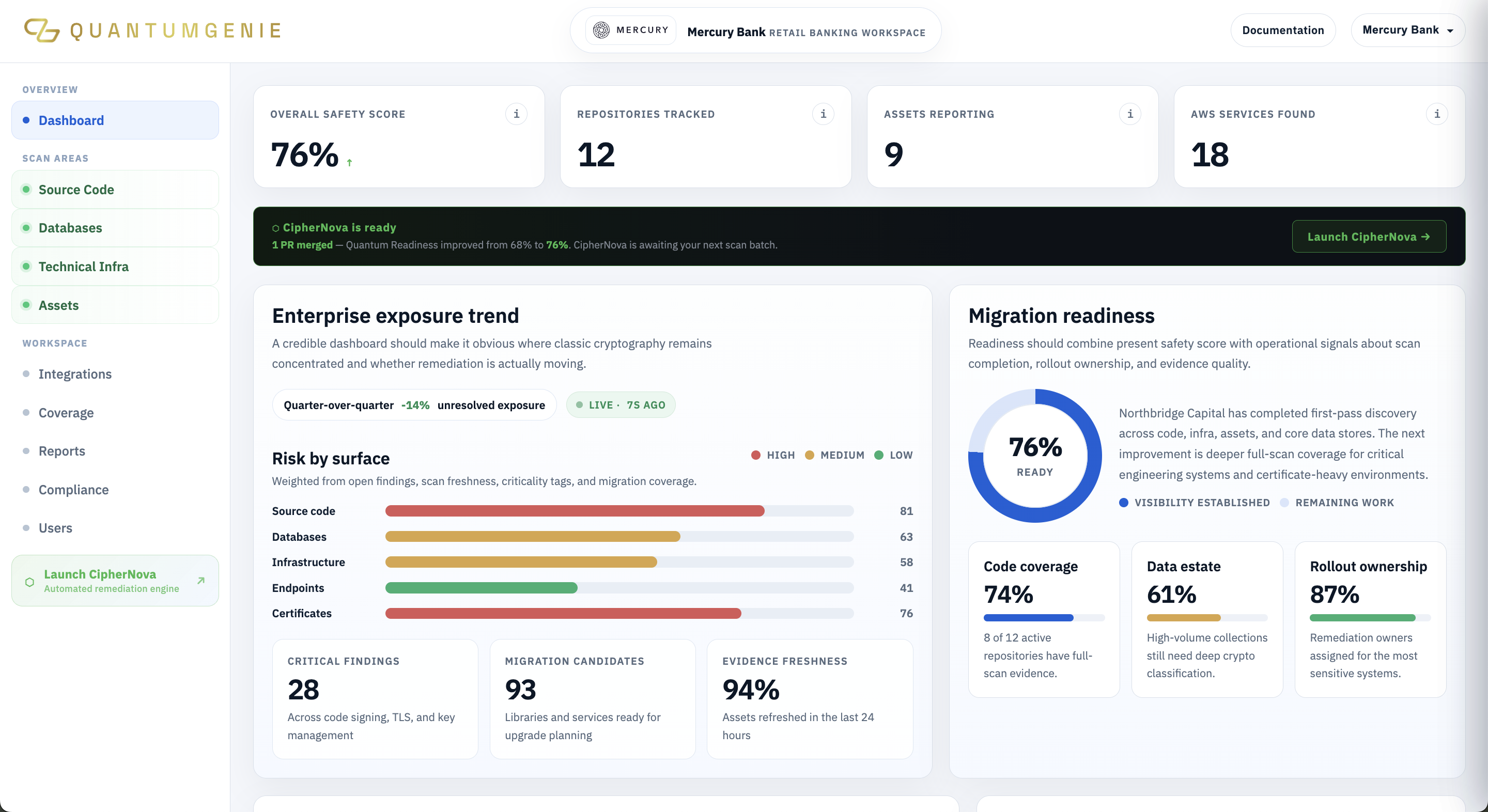
QuantumGenie’s platform aligns perfectly with this emerging paradigm. Our CipherScan product delivers automated cryptographic discovery across websites, certificates, source code, infrastructure, and more — crafting a detailed cryptographic inventory and bill of materials (CBOM). This inventory provides the factual foundation needed to assess quantum risk and prioritize remediation.
Beyond discovery, QuantumGenie’s CipherNova solution supports operationalizing remediation plans through pull requests, policy exceptions, and workflow checks, enabling teams to maintain crypto-agility continuously. By integrating visibility with governance and migration workflows, QuantumGenie addresses the full lifecycle challenge enterprises face in preparing for quantum-safe cryptography.
Frequently Asked Questions
Why is cryptographic inventory critical for post-quantum readiness?
A thorough cryptographic inventory reveals all algorithms in use across an enterprise, including hidden or legacy implementations. This visibility is essential to identify vulnerable systems, assess quantum risks accurately, and create an effective migration plan that minimizes disruption.
How does operationalizing remediation workflows improve migration outcomes?
Operational workflows coordinate planning, change reviews, and testing of algorithm replacements, ensuring that remediation is systematic, traceable, and aligned with evolving standards. This reduces errors, accelerates migration, and sustains crypto-agility in a changing threat landscape.
Watch The Quantum Threat
Sources And Further Reading
- Qinsight's Cryptographic Posture Management Platform Enhances Quantum Readiness Qinsight · Jun 28, 2026
- PKWARE Re-Engineers Key Management for Continuous Cryptographic Change PKWARE · Jun 1, 2026
- Cybernonics Introduces QuantumGuard Post-Quantum Cryptography Platform Cybernonics · Jun 29, 2026